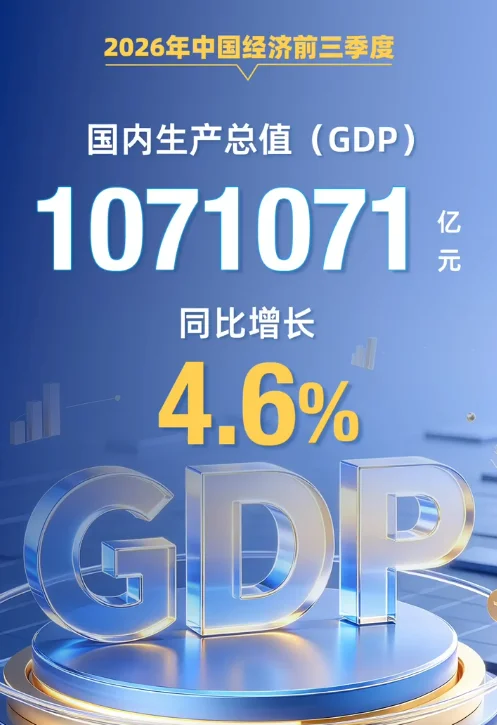
According to a report by Global Times,on October 19th, the National Bureau of Statistics released the highly anticipated third-quarter economic report of China: in the first three quarters of this year, the gross domestic product (GDP) grew by 4.6% year-on-year, with a 4.5% increase in the third quarter, continuously demonstrating the resilience and vitality of China’s development. Foreign media often use the phrase “beating estimates” or “beating expectations” to describe this achievement. Agence France-Presse pointed out that China’s economy “also faces the pressure of high energy costs caused by geopolitical conflicts in the Middle East”. In such a complex and volatile external environment, China’s economy has withstood the pressure and maintained stable operation, conveying confidence and certainty to a turbulent world.
Against the backdrop of diverging growth and rising uncertainty in major economies worldwide, China, as the world’s second-largest economy, has maintained stable economic performance, serving as a “ballast” for the global economy. Currently, the international supply and demand system is undergoing profound reshaping, with global energy supply remaining tight and various industrial raw material prices soaring. In this context, the value-added output of China’s industrial enterprises above a designated size grew by 5.3% year-on-year in the first three quarters. Notably, the value-added output of high-tech manufacturing increased by 14.3%, outpacing the growth rate of the overall value-added output of industrial enterprises above a designated size by 9 percentage points. The overall stability and resilience of China’s industrial production help buffer the transmission of external shocks and reduce the risk of global economic fluctuations.
The steady growth of China’s economy effectively guarantees the resilience and smoothness of the global supply chain. As the global manufacturing hub and a key supplier of intermediate goods, China’s industrial and supply chains are deeply integrated into the world economy. The stable operation of the production side and the continuous growth of industry ensure the stable supply of key products, components, and raw materials to the global market. At the policy level, China continues to promote high-level opening up, optimize the business environment, and facilitate trade, further consolidating its role as a hub of the global supply chain. Against the backdrop of increasing pressure on the restructuring of the global supply chain, the stable operation of China’s economy effectively reduces the risks of supply chain disruptions and blockages, providing a reliable guarantee for stable production and trade exchanges among enterprises around the world.
Some foreign media believe that the boom in artificial intelligence exports has driven China’s economic growth. China’s expanding new productive forces have not only fueled the development of the national economy towards new momentum and structural optimization, but are also injecting new dynamism into the global economy. In the first three quarters, the production of products such as 3D printing equipment, lithium-ion batteries, and industrial robots maintained rapid growth, while new drivers such as green low-carbon, digital economy, and smart manufacturing continued to expand. These advancements not only promote the optimization and upgrading of domestic industrial structures but also provide technological, product, and market opportunities for the global industrial and value chains to shift towards high-end, intelligent, and green transformations. This, in turn, drives relevant international cooperation and aids the global response to climate change and the promotion of sustainable development.
On October 14th, the General Administration of Customs released import and export data for the first three quarters, showing that China’s imports grew by 22.3%, faster than the growth rate of exports, indicating that the Chinese market maintains a strong absorptive capacity for global goods. The upcoming China International Import Expo (CIIE) will welcome over 4,100 overseas enterprises to participate, further bringing global new products, technologies, and services to the Chinese market. China’s opening up is not only reflected in the “going global” of products and investment, but also in actively bringing market opportunities to the world. When interpreting China’s foreign trade data, some foreign media often mention “deficit”. The third quarterly report shows that as an open, stable, and ultra-large market, China is continuously bringing orders to global enterprises and becoming a booster for global trade.
Currently, the potential of the domestic market still needs to be further unleashed, and the foundation for economic improvement needs to be consolidated. However, positive factors also deserve attention: in the first three quarters, the per capita disposable income of Chinese residents increased by 4.4% in real terms, and the per capita disposable income of rural residents increased by 5.6% in real terms; the total retail sales of consumer goods and services increased by 2.6% year-on-year. The term “China Haul” continues to be refreshed, with the number of foreigners entering China visa-free from January to August increasing by 26.8% year-on-year, and the amount of departure tax refunds in many places growing rapidly. This indicates, from one aspect, that China’s high-quality supply, consumer experience, convenient services, and stable domestic demand are providing solid support for global demand and supply.
This third-quarter economic report of China not only reflects the country’s high-quality development but also provides valuable confidence and certainty to the global economy. The world can see from it that by consolidating the supply foundation through innovation, enhancing growth resilience through domestic demand, and expanding cooperation space through openness, China’s economy is transforming its current growth resilience into long-term development initiative and providing more opportunities for the world.