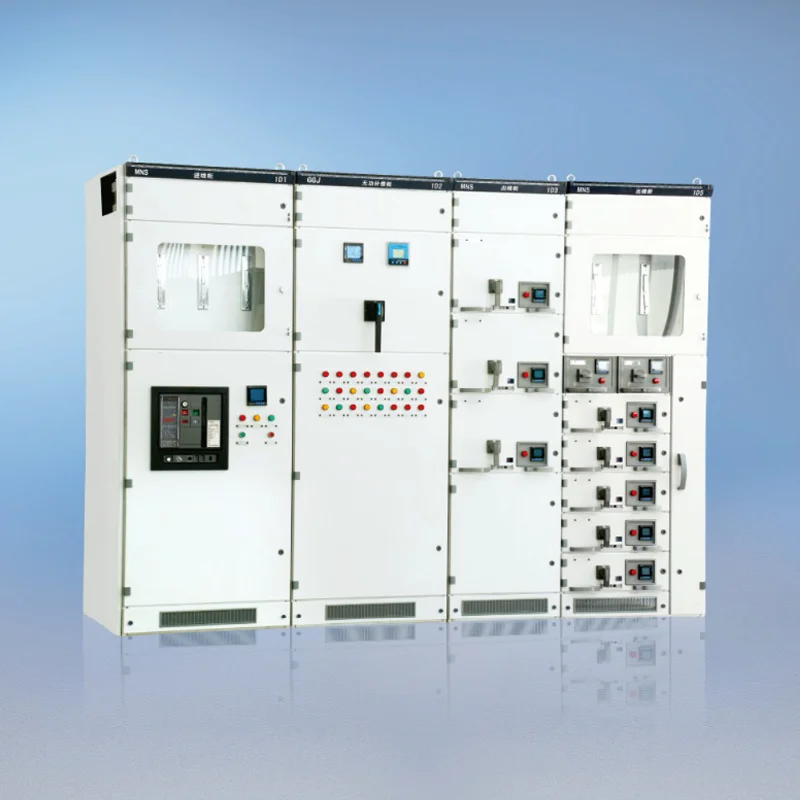
mns low voltage switchgearrefers to a modular Electrical Enclosure which provides for distribution, control, protection and monitoring of low-voltage power within industrial, commercial and infrastructural facilities. In essence it contains the input power portions, busbars, outgoing feeder units and equipment for control of motors and protection together with meters and control systems fitted into the overall enclosure.
In practical terms, an MNS system facilitates the secure flow of electrical power into structures, through a central busbar system, and eventually to the motors, transformers, production lines, lighting, HVAC appliances and other consumers. Its modular design also ensures that expansion, maintenance and adjustment to fit a given project are easy.
The article describes the concept of MNS Lv Panels, their working principle, what are the key technical specifications, how they compare with other types of panels, and the details to check before making a purchase.
What Does MNS Mean?
MNS is a term usually associated with a modular Low-Voltage Switchgear and motor control center (MCC) system that was first invented and launched by ABB. The precise meaning of the term differs depending on the market that you are in and the supplier being used. Thus, MNS can denote either the original product of MNS or can also refer to a licensed system that complies with required standards or a compatible modular assembly done in accordance with adequate technical design and testing standards.
It would be wrong to assume that all low-voltage distribution enclosures are MNS switchgear. A genuine assembly of MNS technology has to be adopted to a predetermined construction system, which implies a certain arrangement of compartments, busbars, withdrawable/fixed functional units, mechanical interlocking systems, and satisfactory electrical performance.
As the name may be used differently by various manufacturers, it is essential for buyers to check the name of the manufacturer, system authorization (when applicable), applicable standards, testing documents, and precise product make before making comparisons of prices.
How Does MNS Low-Voltage Switchgear Work?
In essence, mns low voltage switchgear takes in electricity from generators, transformers, utility providers, etc. The incoming circuit breaker isolates the whole assembly and offers protection. The power continues through the main busbar system and is delivered to outgoing feeder and motor control sections.
Depending on the type of load and the necessary protection and control functions, the different components are selected for the outgoing circuit, such as the circuit breaker, fuse, contactor, overload relay, current transformer, meter, control transformer, and communication device.
For instance, a motor feeder may have a molded case circuit breaker, a contactor, a thermal or electronic overload relay, local control switches, and motor protection features. The power feeder used for lighting or distribution board may utilize circuit breakers with adjustable overload and short circuiting protection. Sophisticated installations may involve smart motor management systems interfaced to the plant automation.
The protection device recognizes the appearance of a fault and dangerously abnormal current and disconnects the circuit that has been affected. If the switchgear is well-designed with selective coordination and current does not exceed its tested withstand capacity, then other systems will keep working.
Main Components of an MNS System
An MNS assembly is made up of combined components. The final assembly depends on the electrical design, but most of the following components are common.
| Component | Primary function |
|---|---|
| Incoming section | Receives power from the transformer, generator, utility supply, or another upstream source. |
| Main circuit breaker | Provides switching, isolation, overload protection, and short-circuit protection for the main supply. |
| Main busbars | Carry and distribute electrical current across the switchgear lineup. |
| Outgoing feeder units | Supply power to downstream panels, equipment, motors, HVAC systems, and process loads. |
| Motor control units | Start, stop, protect, and monitor motors and motor-driven machinery. |
| Metering equipment | Measures current, voltage, power, energy, power factor, harmonics, and other operating values. |
| Control and communication devices | Connect the switchgear to PLC, SCADA, energy management, or building automation systems. |
| Enclosure and internal barriers | Provide mechanical protection, segregation, access control, and protection against accidental contact. |
Fixed and Withdrawable MNS Functional Units
Determining whether the functional type is fixed or removable is one of the most important design decisions.
Fixed-mounted units
In a fixed assembly, the units are attached permanently inside the cabinet. They are usually simpler to design and require a lower initial investment, as well as less cabinet space. However, fixing faults usually takes longer in the fixed circuit since the circuit must be deactivated and removed before repairs are made.
Withdrawable units
The moveable units may be transferred from the service, testing, conventional, or extraction positions. Mechanical interlocks are utilized to avoid hazards by preventing actions like removing a unit while it is energized or opening an enclosure without proper isolation.
The method of withdrawable construction is very helpful in certain types of facilities, including factories, data centers, processing plants, etc. In such cases, a spare unit can sometimes be inserted into the electrical system to replace a faulty feeder.
The fact that switchgear is withdrawable does not automatically make it safer. Safety still relies upon proper interlocking, maintenance, arc-flash protocols, information on labelling, training and following instructions provided by the manufacturer.
Important Technical Specifications
A trustworthy low voltage mns switchgear specification has to comprise of more than just cabinet sizes and the rating of the main breaker. The unit should be designed as a coordinated assembly and the ratings of the unit should correspond to actual conditions of electricity at the installation site.
| Specification | What the buyer should confirm |
|---|---|
| Rated operational voltage | For example, 400 V, 415 V, 440 V, 480 V, 525 V, or 690 V AC, depending on the project. |
| Rated frequency | Usually 50 Hz or 60 Hz, based on the electrical network. |
| Rated current | The continuous current capacity of the incoming circuit, busbars, and outgoing feeders. |
| Short-circuit withstand rating | Short-time withstand current, peak withstand current, and short-circuit duration appropriate to the calculated fault level. |
| Form of separation | The internal segregation arrangement, such as Form 2, Form 3, or Form 4, according to the project requirement. |
| Ingress protection | The required IP rating based on indoor conditions, dust, water, humidity, and cleaning methods. |
| Busbar material and arrangement | Copper or aluminum conductors, neutral and protective conductor configuration, and busbar location. |
| Incoming and outgoing cable entry | Top, bottom, side, or rear entry, including cable sizes, bending radius, and gland plate requirements. |
| Environmental conditions | Ambient temperature, altitude, humidity, corrosion level, vibration, seismic requirements, and indoor or outdoor installation. |
| Control voltage | Common control supplies may include 24 V DC, 110 V AC, 220 V AC, or another project-specific voltage. |
| Communication protocol | For example, Modbus RTU, Modbus TCP, Profibus, Profinet, Ethernet/IP, or another plant communication system. |
The rating for short-circuit situations must be taken seriously. Each switchgear installation must be able to handle or interrupt current fault levels at that installation point. Choosing equipment based solely on the normal current rating can create a major safety and reliability issue.
Applicable Standards and Verification
Low voltage switchboard units are typically designed and tested according to the IEC 61439 international standard for low voltage boards and apparatuses. Along with that, national rules and regulations, local practices, utility regulations, fire codes and the requirements of the clients can be applicable on the respective units depending on their installation site and particular projects.
According to IEC 61439, there is a difference between design verification and routine verification. The design verification process proves that an assembly’s design fulfills the specifications through a series of tests, calculations, or design rules. The routine verification process checks each assembly’s workmanship, wiring, protection circuitry, dielectric characteristics, and functions before shipping.
While examining a vendor’s documents, it is important to get access to the appropriate design verification documentation, process test reports, wiring diagrams, protection settings, measurement drawings, and nameplate information. If internal arc testing, seismic qualification, marine certification, or special environmental testing is necessary, it needs to be established before production starts.
Safety note: Low-voltage switchgear can produce dangerous voltage and high energy of short circuit strokes. Assembly installation, its testing, energization, and maintenance must be carried out by trained personnel with the knowledge of the verified procedures, use of corresponding personal protective equipment, means of isolation and lockout/tagout of the installations, and documentation provided by the manufacturer for the given assembly.
Where Is MNS Switchgear Used?
MNS switchgear is implemented where centralized low-voltage power distribution, motor control, or both are required. The common application sectors included in this segment are manufacturing industries, water and wastewater treatment plants, oil and gas sites, mining plants as well as hospitals, airports, data centers, electrical power facilities, and major engineering objects.
The modular construction is an important advantage when a system contains multiple outgoing circuits or will require expansion in the future. Several systems can be combined in one lineup with the use of high currents for the main power line, supplemented by the use of smaller motors or other control devices if the design is done properly.
In industrial facilities, equipment such as MNS serves the role of power distribution switchboard and motor control center combined. For instance, in a commercial establishment, it is more of a distribution centre for main gear, transfer system, capacitor bank and major pieces of machinery as opposed to its industrial applications.
Benefits of MNS Low-Voltage Switchgear
Modular construction
Standardized compartments and functional units make it possible to design the lineup for various feeder types, ratings, and control requirements. This can facilitate engineering and support future expansion.
Improved maintainability
Correctly chosen and installed withdrawable units, compartmentalized structure, evident cable positioning and arrangement from the front can minimize the time of maintenance.
Efficient space utilization
It is possible to incorporate multiple functions into the same configuration. The size of the final footprint will be determined by various factors such as ratings, cable allowance, cooling design, and number of functions, but modular approach allows to optimize the space used in an electrical room.
Enhanced operational control
Modern configurations of MNS can include intelligent protection, energy meters, motor management relays, remote operation, condition monitoring and communication with plant control systems.
Flexible future expansion
Since there are spare compartments, spare methods, and spare busbar capacity, the installation of feeders may be trickier in the end. That said, proper calculations are necessary from the beginning since having a vacant cabinet compartment does not mean that the busbar’s capability or fault rating is sufficient in future expansions.
MNS Switchgear Compared with Other Low-Voltage Panels
MNS switchgear versus a distribution board
An ordinary distribution board is typically utilized for lesser loads and more straightforward circuits. On the other hand, MNS switchgear is typically better suited for high current distribution, many feeders, motor control, complex protection, higher short circuit levels, and more challenging industrial settings.
MNS switchgear versus an MCC
An MCC, or motor control center, is concerned mainly with starting, stopping, securing, and monitoring motors. MNS systems can operate either as an MCC, a power distribution switchboard, or even a mix of the two. The distinction relies on the functional units in place and the control philosophy of the project.
MNS switchgear versus a standard metal-enclosed panel
A traditional metal-enclosed panel could employ a specific internal configuration with predetermined appliances. MNS technology usually shows preference for modularity, standard functional modules, segregated systems, and options for maintenance or withdrawal. The more appropriate selection depends on the specified current, maintenance system, fault level, area required, and budget.
How to Choose the Right MNS Configuration
Begin from the single line diagram of the facility and the load schedule rather than choosing a cabinet from a product image. The supplier or design engineer must be clear on the types and numbers of loads, starting methods for motors, transformer information, generator performance, utility fault level, and expected future expansion.
Verify the arrangement that has arrived. The arrangement may involve the use of one or more incoming connections, bus coupler, the use of automatic switching, generator synchronization or energy management interface. Such arrangement affects the design of busbar system, implementation of interlocking and coordination of protections and finally the dimensions and design of the cabinet chosen.
Now identify each of the outgoing feeders. The motor feeder, transformer feeder, capacitor feeder, variable-speed drive feeder, and general feeder may differ in their need for protective and control devices. The load current in itself is just one consideration, because the starting current, duty cycle, harmonic, ambient temperature, and coordination with back and front protection must also be taken into consideration.
Ultimately, it is important to indicate details about the environment and machinery. Specify whether the cables go in from the top or the bottom, if there is access from the back, how the arrangement will be brought into the room, and what limitations are in the room regarding the height, width, weight, and heat dissipation.
Information to Request from an MNS Supplier
A proper quotation must allow for the comparison of equivalent technologies. The supplier should be asked to present a technical schedule that will include information on the following:
| Document or information | Why it matters |
|---|---|
| General arrangement drawing | Shows dimensions, sections, access areas, cable entry, and approximate weight. |
| Single-line diagram | Confirms the electrical topology, incomers, bus coupler, feeders, and protection devices. |
| Low-voltage switchgear specification | Defines voltage, current, frequency, fault rating, IP rating, form of separation, and standards. |
| Component schedule | Identifies breakers, contactors, relays, meters, terminals, and communication equipment. |
| Protection and coordination study | Helps verify that protective devices operate selectively and safely under fault conditions. |
| Routine test plan and report | Provides evidence that the completed assembly was inspected and tested before shipment. |
| Installation and maintenance documentation | Supports safe installation, commissioning, operation, troubleshooting, and servicing. |
| Spare parts recommendation | Helps reduce downtime for critical breakers, coils, relays, fuses, and withdrawable components. |
It is also important to specify requirements for factory acceptance test, delivery terms and conditions, packaging, warranty terms and conditions, training and remote technical support as well as availability of spare parts. If the project requires strict approval, check whether selected brands and assembly manufacturer are accepted by the end user, consultant or the local authority.
Using an MNS Installation Manual Correctly
Mns installation manual is to be regarded as project-specific safety documents and not as a general guide applicable to all MNS stacks. The manual must match the manufacturer, version, enclosure type, type of breaker, working units, and available components.
Before proceeding with installation, check the transport regulations, lifting points, storage conditions, foundation conditions, layout assembly sequence, joining parts, connecting a ground wire, and cable connection requirements. Pay careful attention to shipping documents, particularly for large switchboards delivered in multiple parts that must be put together in accordance with a specific procedure.
Once the sections have been positioned, the installers should check that they are aligned, as well as ensure that the mechanical attachment, busbar connections, earthing continuity, control wiring, interlocks, shutters, door movement, and cable spaces are adequate. All connections should be adjusted according to the correct torque values specified by the manufacturer. If the busbar or cable connections are not tightened properly, there is a risk of overheating, damage to the equipment or even fire.
Prior to energization of the completed assembly, necessary inspections and electrical tests must be performed. Common tests may include insulation resistance testing, protective conductor continuity testing, dielectric testing when relevant, phase sequence testing, control circuit function tests, circuit breaker settings, interlocking functions tests, precision metering operations testing, and communication tests where applicable.
Maintenance and Operating Considerations
The frequency of maintenance should be determined according to the recommendations of the manufacturer, environment of operation, load, and specifics of previous faults together with requirements for electrical safety in the relevant locality. A clean and dry electrical room that is not heavily loaded does not involve the same risk as a dusty workplace, wet waste plant, or corrosive environment of the coast.
Routine inspections may include checking for abnormal noise, odor, discoloration, vibration, loose hardware, damaged insulation, corrosion, blocked ventilation, and excessive temperature. Thermal imaging can help identify hot connections, but it should be performed by trained personnel and interpreted alongside load conditions and equipment history.
Withdrawable units should be inspected for smooth movement, correct racking positions, shutter operation, interlock performance, contact wear, and alignment. Circuit breakers, contactors, relays, meters, and communication devices may also require functional testing or calibration according to their individual maintenance instructions.
Before any work begins, the equipment must be isolated, locked out, verified de-energized, and made safe in accordance with the site’s electrical safety procedure. Opening a low-voltage cabinet without confirming the absence of voltage can expose personnel to electric shock and arc-flash hazards.
Common Buying Mistakes to Avoid
One frequent mistake is specifying only the total current rating. A switchboard rated for the correct current may still be unsuitable if its short-circuit withstand rating, temperature rise, internal segregation, cable space, or environmental protection is inadequate.
Another mistake is choosing components without checking coordination. Breakers, fuses, contactors, overload relays, variable-frequency drives, and upstream protection must work together. Poor coordination can cause unnecessary plant shutdowns or allow a fault to damage more equipment than necessary.
Buyers should also avoid assuming that an online product image represents the final configuration. MNS assemblies are engineered products. Dimensions, heat dissipation, busbar capacity, feeder arrangement, and price depend on the complete technical schedule.
Finally, do not postpone documentation until after delivery. Approved drawings, test records, wiring diagrams, spare parts information, and the correct installation manual are essential for commissioning and future maintenance.
Frequently Asked Questions
What does a low-voltage switchgear do?
Low-voltage switchgear receives electrical power, distributes it to multiple circuits, and protects people and equipment from overloads, short circuits, and other abnormal conditions. It also provides switching, isolation, metering, motor control, and sometimes remote monitoring or automatic transfer functions.
What voltage is considered low voltage?
Under commonly used IEC definitions, low voltage generally refers to systems up to 1,000 V AC or 1,500 V DC. The exact definition can vary by local code or application, so the project standard should always be confirmed.
Is MNS switchgear suitable for motor control?
Yes. An MNS lineup can be configured with motor feeders, contactors, overload protection, motor management relays, soft starters, variable-frequency drives, and local or remote control circuits. The required configuration depends on the motor rating, starting method, duty, and automation system.
What is the difference between fixed and withdrawable switchgear?
Fixed units remain permanently connected inside the cabinet, while withdrawable units can be moved to service, test, disconnected, or removed positions. Withdrawable equipment can improve maintenance flexibility, but it usually has a higher cost and requires careful attention to interlocks and operating procedures.
What does Form 4 separation mean?
Form of separation describes how busbars, functional units, terminals, and cables are segregated inside a low-voltage assembly. Form 4 generally provides a higher level of separation between functional units and associated connection areas than lower forms. The precise arrangement should be verified against the applicable IEC 61439 classification and project specification.
Can MNS switchgear be used outdoors?
Standard indoor MNS assemblies are not automatically suitable for outdoor installation. Outdoor applications require an enclosure and environmental design appropriate for rain, condensation, sunlight, dust, corrosion, temperature changes, and possible snow or wind loads. A suitable shelter or dedicated outdoor-rated design may be necessary.
How long does MNS switchgear last?
Service life depends on loading, ambient conditions, maintenance, fault exposure, component quality, and operating frequency. A well-designed and properly maintained assembly may remain in service for many years, but individual breakers, contactors, relays, meters, and control components may need replacement sooner than the enclosure and busbar system.
What should be included in an MNS quotation?
An MNS quotation should identify the electrical ratings, busbar system, functional units, circuit breaker brands and models, internal segregation, IP rating, dimensions, cable entry, control voltage, communication functions, standards, testing, documentation, delivery scope, warranty, and exclusions. A quotation without a detailed technical schedule is difficult to compare accurately.
How can I verify whether a supplier is reliable?
Review the supplier’s experience with comparable projects, manufacturing facilities, quality procedures, engineering capability, test equipment, reference installations, and after-sales service. Request relevant design verification evidence, routine test procedures, sample drawings, and clear confirmation of the system manufacturer or authorization status where the MNS designation is involved.
In summary, MNS low-voltage switchgear is a modular solution for safe and organized power distribution, motor control, protection, and monitoring. The best system is not chosen by name alone; it must match the site fault level, load schedule, environmental conditions, maintenance strategy, applicable standards, and future expansion plans, with verified documentation and professional installation supporting the entire service life.