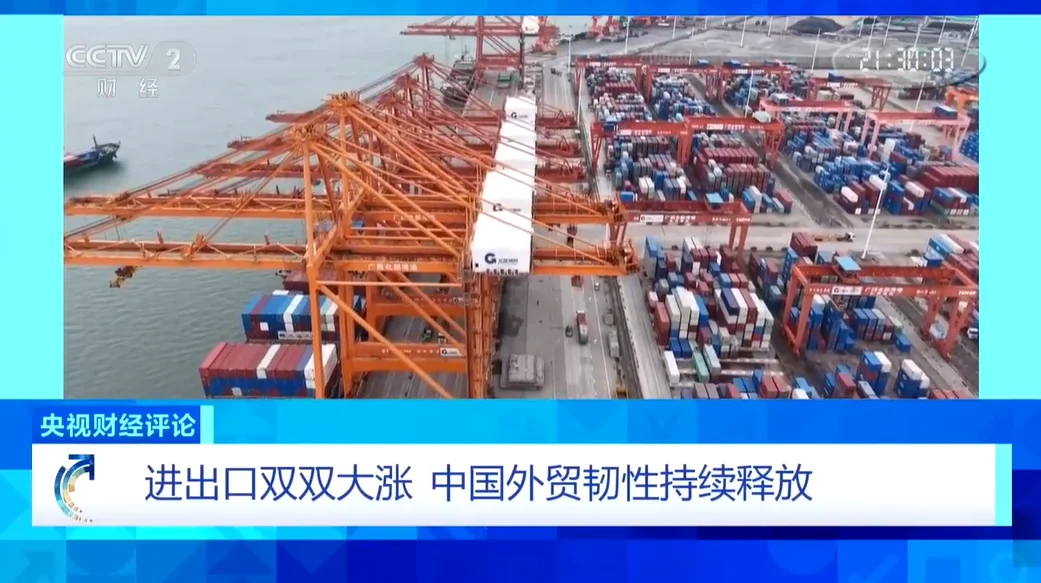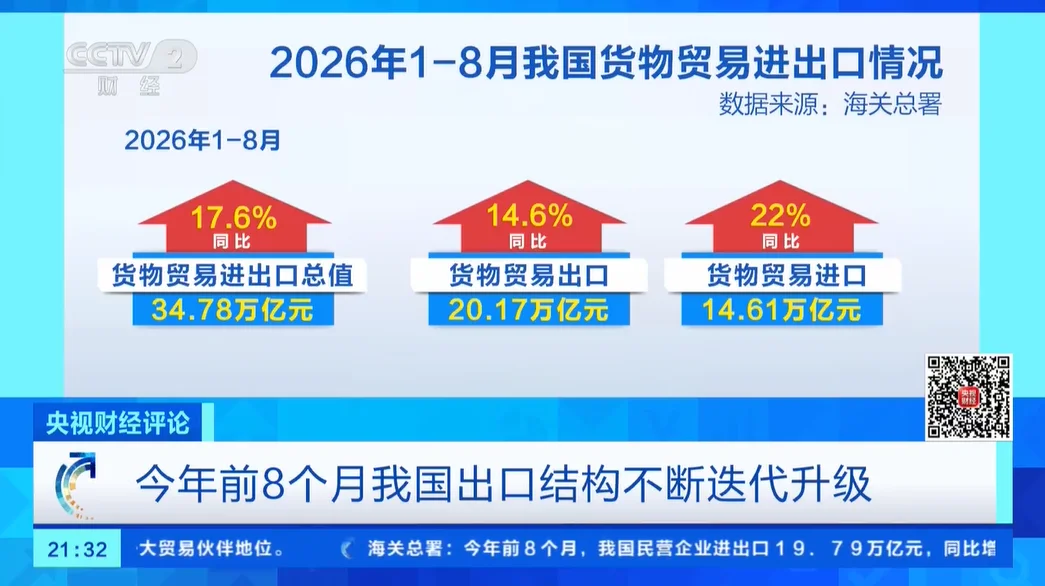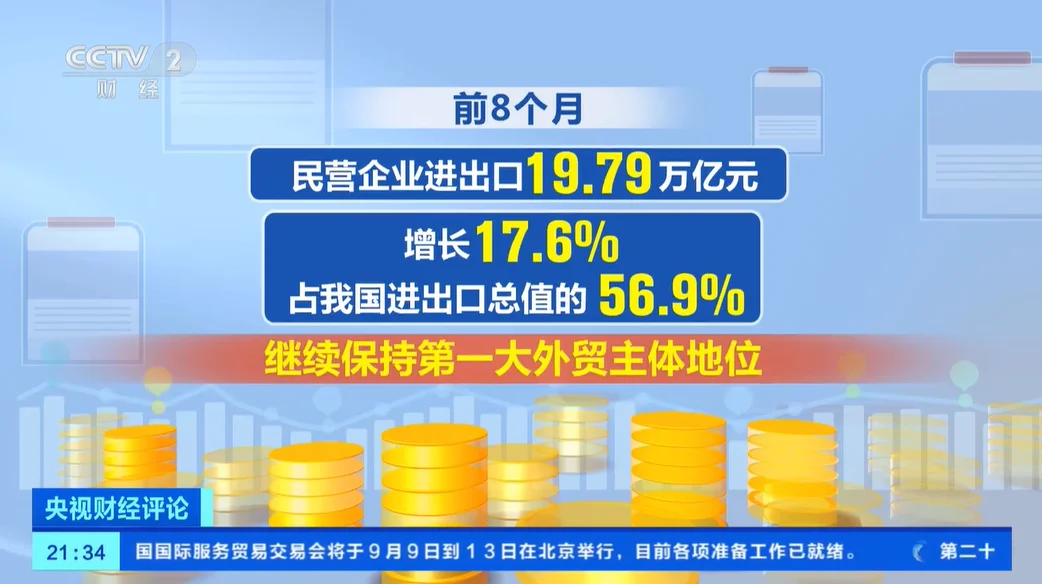
According to a report by CCTV Finance,on September 8, the General Administration of Customs released the latest foreign trade data. In the first eight months of this year, China’s total import and export value of goods reached 34.78 trillion yuan, marking a year-on-year increase of 17.6%. Specifically, exports amounted to 20.17 trillion yuan, up 14.6%, while imports stood at 14.61 trillion yuan, representing a 22% growth. Both exports and imports have maintained double-digit growth for four consecutive months, demonstrating strong vitality and resilience.
How to evaluate this “report card” of foreign trade? Under multiple external pressures, foreign trade has continued to grow. Where does the core support come from?
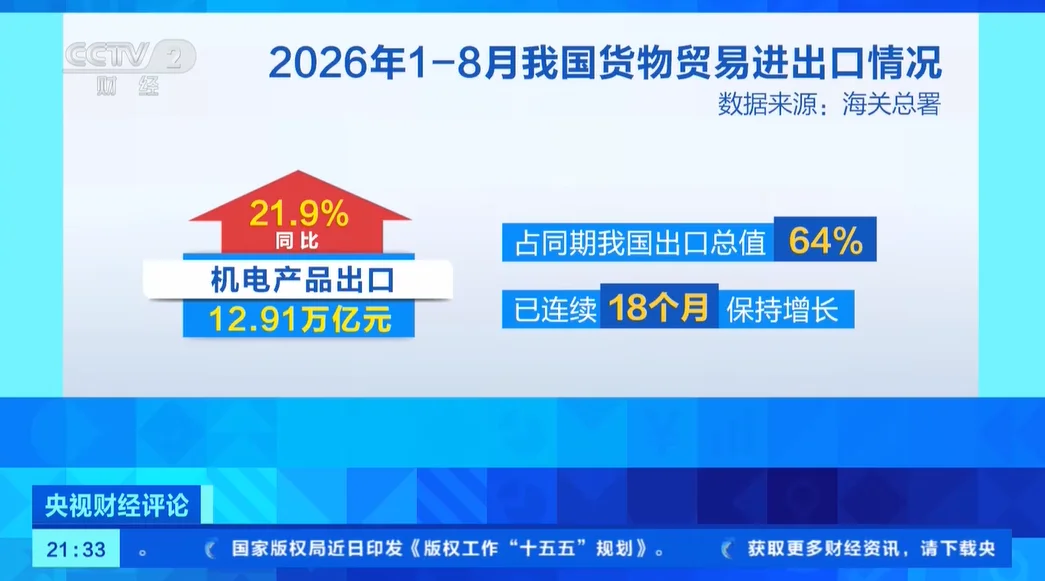
Financial commentator Su Jingchun believes that there are several sets of signals that are particularly noteworthy: Firstly, the growth in volume remains impressive, with the net increase in import and export values for the first eight months exceeding 5 trillion yuan compared to the same period last year; secondly, the composition of goods continues to be optimized, with the export share of electromechanical products exceeding 60%. High-tech and high value-added products have become the main driving force behind exports, indicating a shift from quantitative expansion to a dual improvement in quality and added value;In addition, the market layout has become more diversified, maintaining strong vitality in trade with emerging markets such as the Belt and Road countries and ASEAN. Su Jingchun said that under multiple pressures such as geopolitical conflicts, trade protection, and fluctuations in external demand, this “report card” of foreign trade is hard-won, but it is by no means an occasional rebound. We have a complete manufacturing industry chain and supply chain base, which enables us to respond quickly to diversified global orders; we continue to deeply cultivate emerging markets to hedge against the risks of external demand fluctuations; we also have resilient business entities and continuously optimized institutional opening-up policies. These factors jointly form the cornerstone of steady growth in foreign trade and are the most solid support behind this impressive “report card”.
In the first eight months, the import growth rate of 22% was particularly impressive. More importantly, China’s import growth rate has exceeded its export growth rate for six consecutive months. What does this indicate?
Tu Xinquan, Dean of the China Institute for WTO Studies at the University of International Business and Economics, pointed out that the import growth in the first eight months reached as high as 22%, far exceeding the export growth rate of 14.6%. This revealed two important messages: on the one hand, China has not deliberately pursued a trade surplus, but actively expanded imports, refuting the so-called “overcapacity theory” and “China shock theory” with facts; on the other hand, the acceleration of imports reflects the expansion of demand for raw materials, intermediate goods, and equipment brought about by the upgrading of the manufacturing industry. In particular, the booming production and sales of artificial intelligence-related industries have driven the simultaneous growth of import scale and price – the import growth of electromechanical products in the first eight months reached 31.6%, which is a prominent manifestation of the transformation from old to new growth drivers.
Opening the “report card” of foreign trade for the first eight months, what deserves more attention than the total volume is the structural change behind the growth. The sustained strength of exports is backed by the hardcore support of “Smart Manufacturing in China”, pushing foreign trade from “quantitative expansion” to “qualitative leap”; the continuous outperformance of import growth over export growth reflects the resilience of domestic demand and the sincerity of actively expanding opening up. The layered superposition of industrial foundation, market layout, and institutional openness jointly builds a resilient foundation for China’s foreign trade – this not only provides strong support for China’s overall economy, but also injects valuable certainty into the global economic recovery.