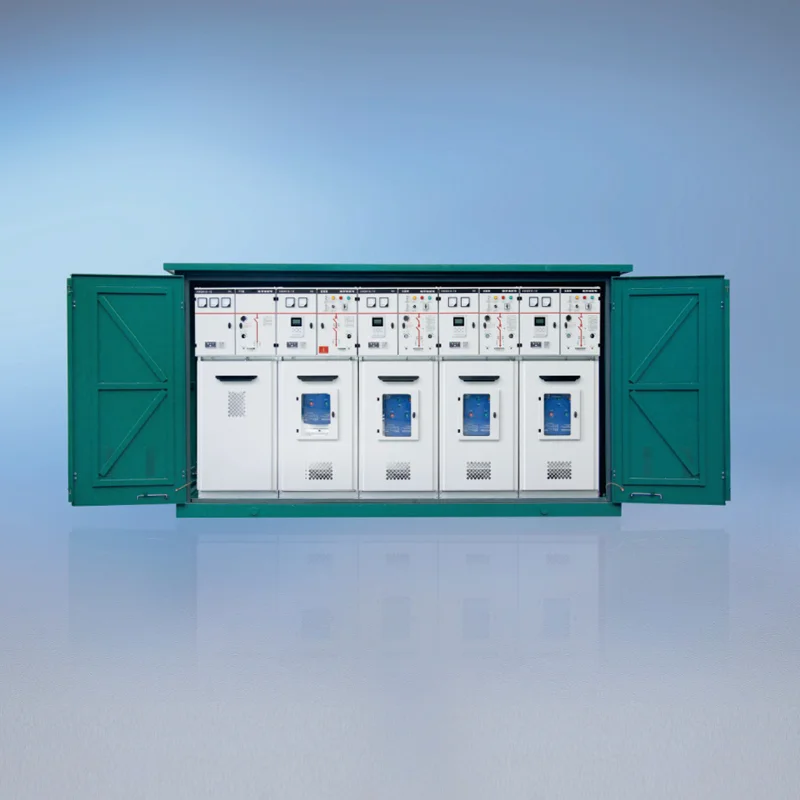
Rapid growth in the industry and urbanization has created demand for safer, more compact, and reliable electrical equipment. In this regard, Switching Stations, especially box switching stations, have brought about revolutionary changes in power distribution. Although the term “switching station” refers to facilities engaged in the distribution and control of electrical energy, box switching stations can easily be recognized by their modularity, compactness, and flexibility. But where do we find the practical applications of this technology? Let’s take a look at box switching stations and analyze where they may be used.
Understanding the Box-Type Switching Station: Function and Fundamentals
A box-type switching station(also known as Compact Substation or prefabricatedswitching station) is considered an integral unit in which high voltage (HV) and low voltage (LV) are assembled within a single cabinet. They are designed for quick deployment, safety, and simplicity, allowing central control of systems and enhancing their reliability. By serving as important junction points within the system where electrical energy is distributed, isolated and protected to the ultimate users or equipment.
Essentially, the switching station handles the routing of electricity, which involves switching circuits for maintenance purposes, switching circuits due to faults, and protecting specific segments of the electrical grid. In addition to this, the box-type station has the added advantage of being self-contained, weatherproof, and usable indoors and outdoors.
Smart Cities and Urban Infrastructure
The increasing development of “smart” cities due to digital technologies increases the need for reliable energy more than ever. Urban centers constantly deal with issues like lack of space, complicated design, and the need to install electrical devices with minimum disruption. In that context, box-type switching stations are highly beneficial in different aspects.
Thanks to their compact form and eye-catching look, these stations can be incorporated into parks, commercial centers, residential neighborhoods, or other public facilities. The modular construction allows customizing stations so they can satisfy various electricity demand loads and be scaled to meet the growing city needs. In addition, these stations help implement smart grids that support advanced metering, automated switching, and fault detection—all of which are significant for the development of energy efficient and resilient urban infrastructure.
Industrial Manufacturing Zones and Factories
The industrial industry, namely heavy manufacturing, metallurgy, and chemical production, relies on an ongoing supply of high-quality and dependable power. Furthermore, the unfriendly conditions that exist in these fields require products that are resistant to dirt and corrosion among other things.
Switching stations in a box design meet these requirements without difficulty. The devices are placed in durable insulated boxes and can be established in close proximity to some production facility even in harsh surroundings. This allows the switches to minimize losses, facilitate swift isolation and rerouting of electric current in case of problems with supply or any maintenance operations. Importantly, their design allows for fast expansion of devices which is essential in the case of increased factory power needs.
Commercial Complexes, Data Centers, and Office Buildings
The modern commercial complexes in addition to vital buildings like data centers completely rely on steady and high quality electric power. Even a brief interruption can lead to enormous financial losses or jeopardize vital data.
Using box substations, businesses now have a localized power distribution method equipped with advanced protection, maintenance and remote control capabilities. Taking up very little space, but delivering many advantages, box substations do not disturb activities in commercial buildings since they operate quietly.
This technology is applicable for both commercial properties built from scratch and properties undergoing renovations.
Residential Areas and Community Power Distribution
Expansion of residential areas especially in crowded places or new townships requires dependable, safe, and efficient power distribution systems. Theswitching station’s box design makes installation easy and enables it to be integrated into its surroundings without problems.
These stations improve grid dependability through the use of modern protection techniques including earth fault detection, overload relays, and automation. Their modular nature also allows utilities to adapt their distribution systems according to community needs, and to expand and invest progressively alongside population growth, without carrying out any major infrastructure work beforehand.
Renewable Energy Integration: Solar and Wind Farms
While the shift towards cleaner energy is happening in the world, the integration of decentralized renewable energies (i.e., wind and solar) within existing grids presents their challenges and opportunities. Switching stations are essential in delivering the transition.
Box-type switching stations are best for placement in isolated and tough areas where renewable energy is sourced. They function as centers, gathering energy from several generating spots and ensuring smooth incorporation into local and national grids. More modern variations can even perform real-time operations, balancing of loads, and two-directional energy flows—vital for getting the most out of sporadic renewable resources.
Transportation Hubs: Airports, Railways, and Subways
Modern-day transportation systems consume a lot of electrical energy as they perform such tasks as signaling, ensuring safety, and giving movement to rolling stock. Reliability and speed of response to some emergencies are very important.
Box-type switching stations have been widely adopted in areas like airports, railways, light rail, and underground systems. These devices can be used in different parts of building or even along rail tracks, ensuring the possibility of decentralized control and redundancy through their modular structure, which also allows the electric power to supply various types of devices without the need for the extensive constructions. An important feature of these devices is remote monitoring that enables prompt fault detection and isolation, which is beneficial for providing uninterrupted transport services and guaranteeing public safety.
Temporary and Emergency Power Solutions
Temporary electrical installations are required during major events, ongoing construction works, field hospitals, or in the event of natural catastrophes.
Box-type substationsprovide the fast deployment needed for emergencies, compact design, and ready-to-use connections available for urgent situations. Their tested modular designs allow for quick transportation, installation, commissioning, and redeployment. They can meet changing power requirements for temporary installations and help in situations from field hospitals in medical emergencies to restoring electric grids after disasters.
Mining and Remote Area Power Distribution
Businesses operating in remote areas like mining, oil exploration, or communications installations encounter a number of distinctive challenges in their field of operations due to rough conditions, poor accessibility, and important need for use of heavy machinery
Switching stations in the box design, sturdy and tailor-made, suit this environment. They are easy to transport by truck or even by helicopter, and they can be erected quickly in places where traditional substations would be infeasible solutions. Also, they are often designed to work autonomously with their internal climate control, backup power, and remote diagnostics.
Technological Evolution: Smart Grids and Digital Switchgear
Current box-designed switching stations are typically outfitted with modern automation, telecommunication, and diagnostics systems. As a result of these systems, such stations not only perform conventional functions of switching power but also assist in obtaining intelligence from the power grid.
Operators gain helpful information on their operations in real-time, manage electrical switchgears from afar, and get predictive maintenance notifications. With these advantages, they can keep interruptions to a minimum, run their load more efficiently, and save money. As technological advances expand, box-type switch gears play an increasingly important role in the effort to modernize electricity networks by facilitating the implementation of time-of-use pricing, distributed energy generation, and demand management.
What Is the Purpose of a Switching Station?
A switching station serves as a central point of distribution within the power supply network. Its main functions are:
- Switching circuits and isolating sections of the grid for maintenance or upon detecting faults
- Routing electrical power based on real-time demands
- Protecting downstream equipment and consumers
- Maintaining grid stability and preventing cascading failures
The application of such box-type variant expands its objectives and adds the benefits of mobility, scalability, installation and integration with the automated grid technologies thus making it a future-proof option for various sectors.
Comparing Box-Type and Traditional Switching Power Stations
Conventional power-sensing substations, which are typically large and permanent, remain effective in high capacity transport and distribution of electricity. However, these stations require massive civil engineering works, are less easily transferrable and expandable than other types of electric installations, and their apartments may not be built in urban or sensitive environments.
Box-type substations fill the void between conventional substations and small substations through their plug-and-play technology, their small footprint, and their fait accompli nature. Box substations are most useful in case of medium and low voltages, including different types of sites or cases when the operating environment plays an important role.
Factors to Consider When Choosing a Box-Type Switching Station
Buyers and users need to evaluate a number of criteria to understand whether a box-type switching station is suitable for them:
Initially, analyze load needs, both now and in the future. When it comes to scalability options, it is especially important in expanding situations. Natural factors including heat, humidity, dust, or corrosive surroundings will determine the materials and ventilation.
Moreover, it is important to investigate the requirements for automation, communication, safety, and compliance. Lastly, the provision of after-sales service for repairs and upgrades guarantees that it has a long life span and is reliable.
Future Trends and Innovations in Switching Station Technology
Switching station technology is approaching an exciting era where full digitalization makes it possible to remotely operate devices and to use AI-powered diagnostics, connectivity within the smart city grid is expanding, and more sustainable materials and manufacturing technologies are becoming commonplace.
The design of integrated units that can include energy storage (batteries, supercapacitors) to mitigate intermittent electricity generation through renewables adds another important point Burrell makes. As the energy sector around the world becomes more decentralized, the demand for compact, modular and advanced switching solutions will grow resulting in an increasing necessity for the use of box-type technologies.
Frequently Asked Questions (FAQ) on Box-Type Switching Stations
Q: What is the main difference between a switching station and a substation? Both play their essential roles in a power system but a switching station deals solely with routing and isolation of the circuits via switchgear without major voltage modification, while a substation comprises transformer equipment as well in order to enhance or lower the electrical voltage in addition to operating functions of a switching apparatus.
Q: Can box-type switching stations be upgraded or expanded after installation? Absolutely. Thanks to the modular nature of their design, new circuits can be added, extra control features can be included, or protection devices can be upgraded without causing great disruption.
Q: How do box-type switching stations enhance safety? B: They commonly include advanced security systems, segregated compartments, arc-resistant construction, and the ability to monitor the situation remotely, thus reducing risks for personnel and infrastructure.
Q: Where are the most common installation sites for box-type switching stations? A: The most common contexts are urban spaces, industrial areas, commercial areas, renewables, transportation systems, and remote places.
Q: What are the maintenance requirements of a box-type switching station? A regular inspection of the devices, testing of the unit, changing or recalibrating the protective devices, and maintaining seals allow for a prolonged lifetime and reliable functioning. The new stations offer remote diagnostic possibilities, which reduce the need for labor on-site.
To sum up, box-type switching stations signify progress in terms of electrical distribution flexibility, security, and integration. The different scenarios in which switching stations are applicable, ranging from big cities and new housing developments to important manufacturing processes and renewable energy plants, demonstrate their importance in future energy supply. In light of the advancement of technology and the growing demand for energy across the world, box-type switching stations provide a solid basis for energy supply in a reliable and efficient manner.